
Thomas Pynchon's SHADOW TICKET, Magritte, and the Art of the Unusual

I am one of those readers, a guy who was assigned two novels by Thomas Pynchon (as well as Lolita and Pale Fire by Pynchon’s one-time professor at Cornell, Vladimir Nabokov) in a college class way back when.
Smitten, the young me.
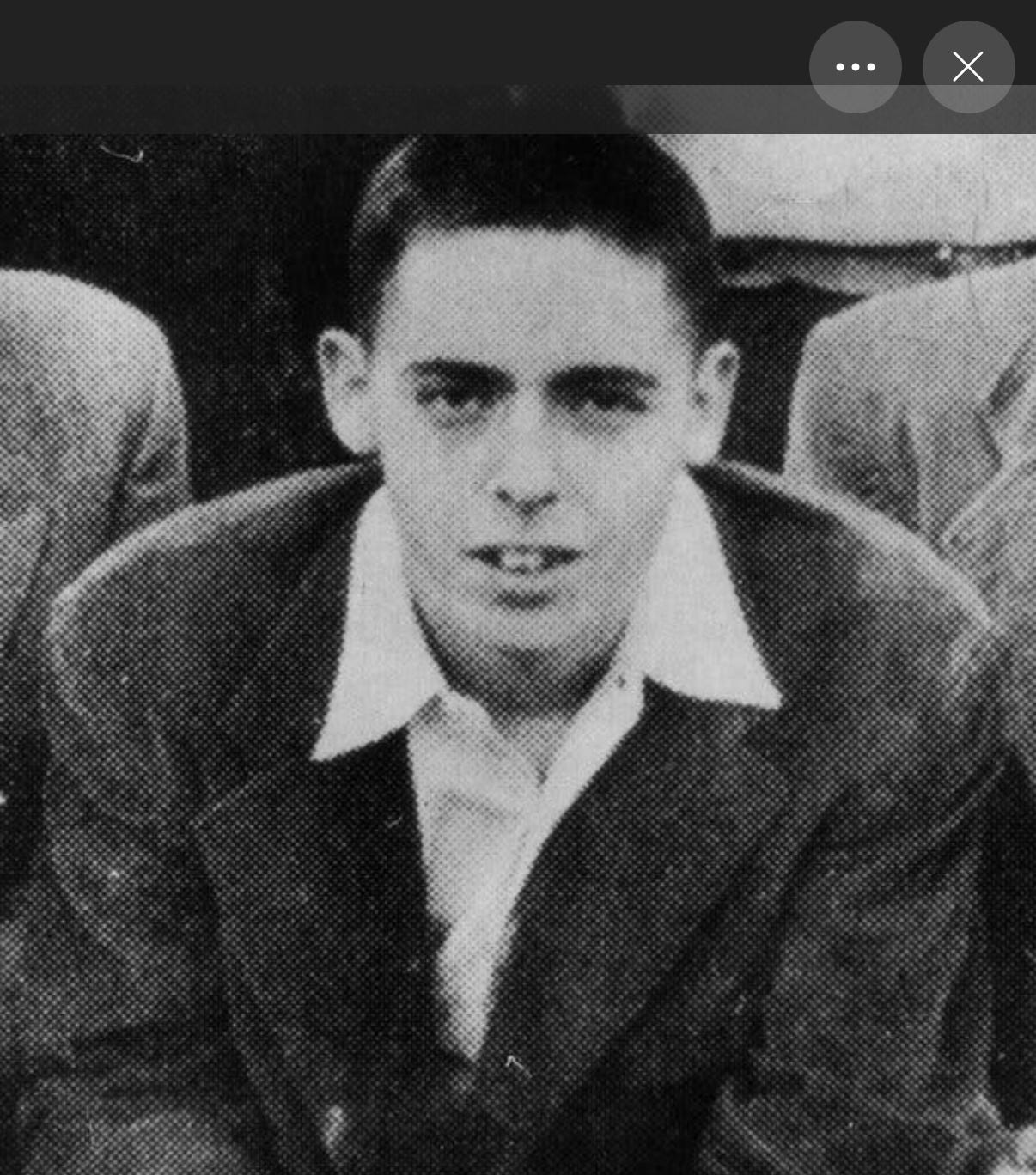
This was in 1981, when Pynchon’s silence after winning the National Book Award for Gravity's Rainbow was only seven years young, at the dawn of the Reagan Revolution that would dominate his next book (Vineland, just this year reimagined by Paul Thomas Anderson as the film One Battle After Another), and before the critical backlash against Pynchon and all things "postmodern" had taken hold in the pages of The New York Times (Ms. Michiko Kakutani but others too) and at large. In my class, neither the professors nor the students used a moment of class to worry that Oedipa and "Mucho" Maas had insufficiently realistic names and insufficiently rich internal emotional lives. No one complained that Pynchon's plots were too dependent on coincidence or that his depiction of a vaudeville-esque pie-throwing fight between two hot air balloons demonstrated juvenile humor. Instead, we laughed. And we marveled at a novelist who dared to suggest that systems - military, scientific, political, psychosexual, and otherwise - were dehumanizing us.
The cartoonish elements of Gravity's Rainbow and The Crying Of Lot 49 were part of the point of these books and, even more dazzlingly, they were counter-balanced by sections and whole chapters that were, in fact, rich in emotion, humanity, and "realism." And all of the writing, sentence by sentence without any filler, was gorgeous - like a John Coltrane improvisation, like a streak of color on a Kandinsky painting, like the movement of arms, legs, and torsos in a dance created by Merce Cunningham.
But literature has fashion too, and when Vineland appeared in 1990 (and as most of Pynchon's subsequent novels appeared thereafter), the refrain had become its own set of repeated critical tropes: enough with the silly song lyrics and crazy names, Tom! Why don't you write with more emotional realism like Raymond Carver, man? The tide turned against other inheritors of Pynchon's style too, whether they vaguely renounced his influence (David Foster Wallace) or wrote positive reviews of his books (Salman Rushdie, Jonathan Lethem).
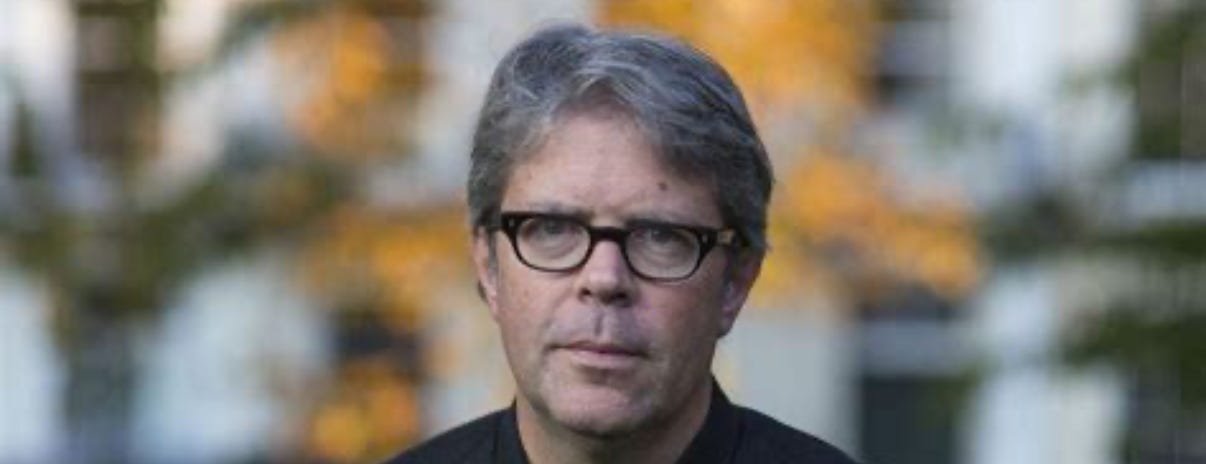
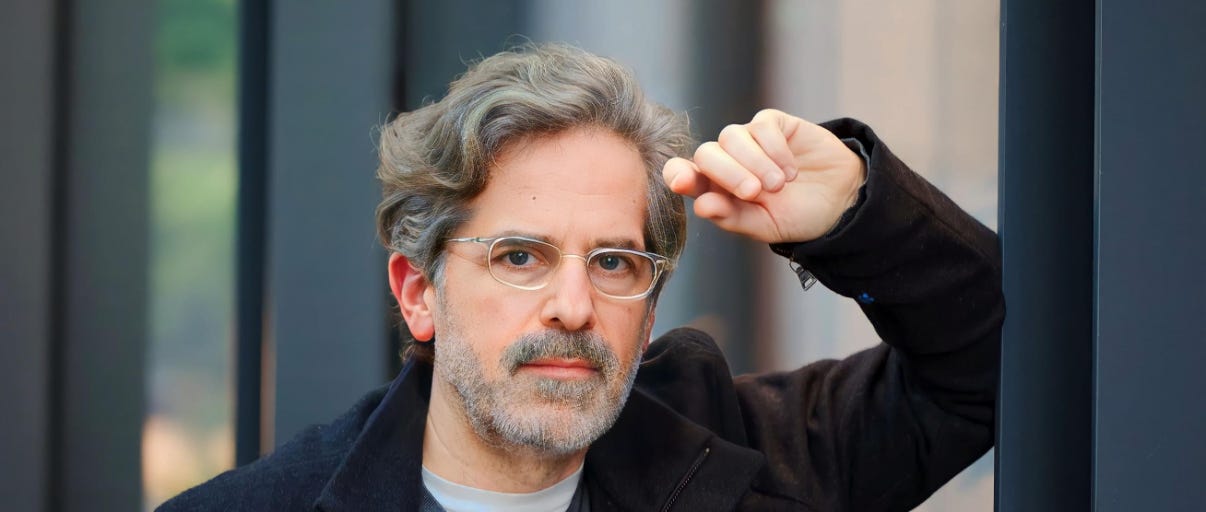
The literati had come vastly to prefer the other Jonathan (Franzen), precisely because his books were un-Pynchonian - about family dynamics and the internal wounds of the human heart. Dogs did not talk in these books. The undead did not gather in hotel ballrooms. People did not cook breakfasts largely from bananas amidst a devastating war.
I didn't dislike those more conventional books but continued to feel that there should be room for both - for many - styles. The novel had been so many things through the centuries. Cervantes wasn't like Franzen, who isn't like Woolf, who wasn't like Roth, and so on.
I had just read the last pages of Thomas Pynchon's most recent novel, Shadow Ticket, as I arrived by train to Brussels from the smaller town of Tournai. From the city's Grand-Place, it was a short walk to the museum honoring the painter Rene Magritte, one of the city's own.
Inside the museum, devoted entirely to Magritte's career and work, we experienced a classic story of a 20th-century artist. He studied at the Académie Royale des Beaux-Arts in Brussels and at the Académie Royale. He served in the Belgian infantry in the years immediately following the First World War, and started his art career as a draftsman and ad man. He flirted with Impressionism and then cubism, but his earliest drawings show that he was a more than capable classical artist. And then a new artistic movement captured his imagination.
Even if you are not an art buff, you know Magritte's most famous images - such as well-dressed man in a bowler hat but with an apple where his face should be. Another, similar man faces the viewer with a pipe, in profile, mysteriously floating in front of his face.
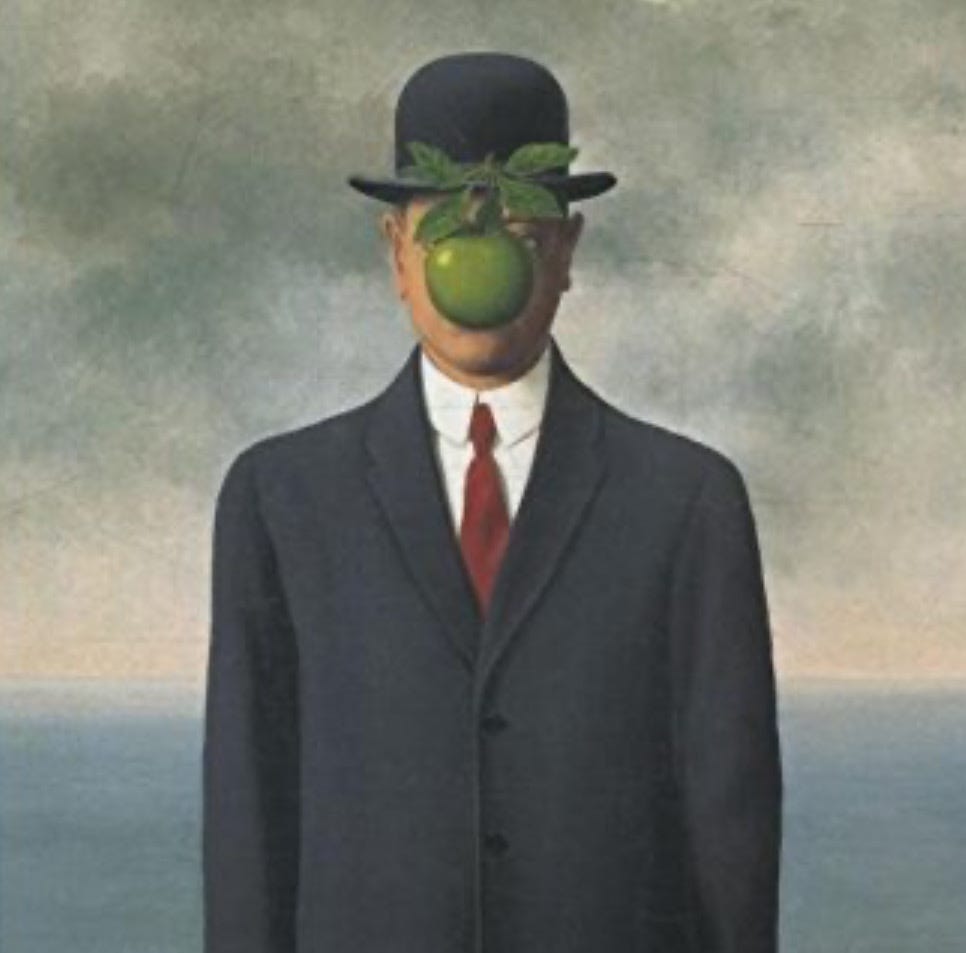
Surrealism was not a simple or narrow movement, though we associate it with a specific moment in time (perhaps as we now think of postmodernism). In Magritte's work, very realistic images are placed out of context, serious portraiture appears in odd places (on an interior wall of a house, cut off in part by a window looking out to the sea, for example), and sentences appear within the frame asking whether what we are seeing is actually a pipe ... or it just a picture of a pipe?
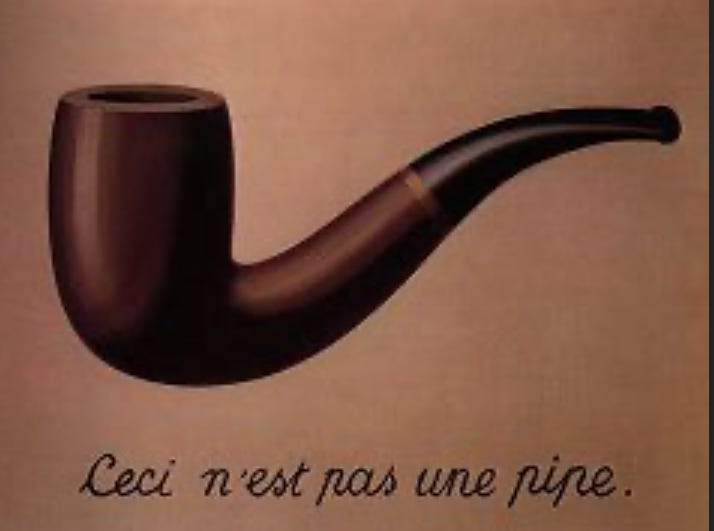
Though painters may no longer be described as working "surrealists," I don't think critics turned on the work itself or came to see it as a fad, and such logical impossibilities did not suddenly become an empty way of making art. Art did not flip backward in time to Impressionism or Romanticism, though Magritte himself did sometimes use Impressionism in his mid-career work.
Thomas Pynchon, too, had moments of increased traditionalism in his work. Mason & Dixon, the fifth of his nine novels, contained his most nuanced character portraits, even if it also featured a talking dog and manic song lyrics. Critics applauded the move toward tradition as if middle-aged Tom had finally grown up and learned to act, or ..., write his age.
But since then, Pynchon has largely (and, it seems, unshit-givingly) disappointed them all over again. Against The Day(2006) was too long and too impersonal, Inherent Vice was a thin detective novel send up centering a California stoner, and Bleeding Edge was more Pynchon Lite - another female detective like Oedipa Mas but without the context of the '60s to excuse her.
Now we have Shadow Ticket, yet another genre story of the gumshoe persuasion. And the critical reaction has been mild. The author's insistence on staying out of the public eye gets ritually trotted out, and then the book gets mostly (though kindly, as Pynchon is 88) dismissed.
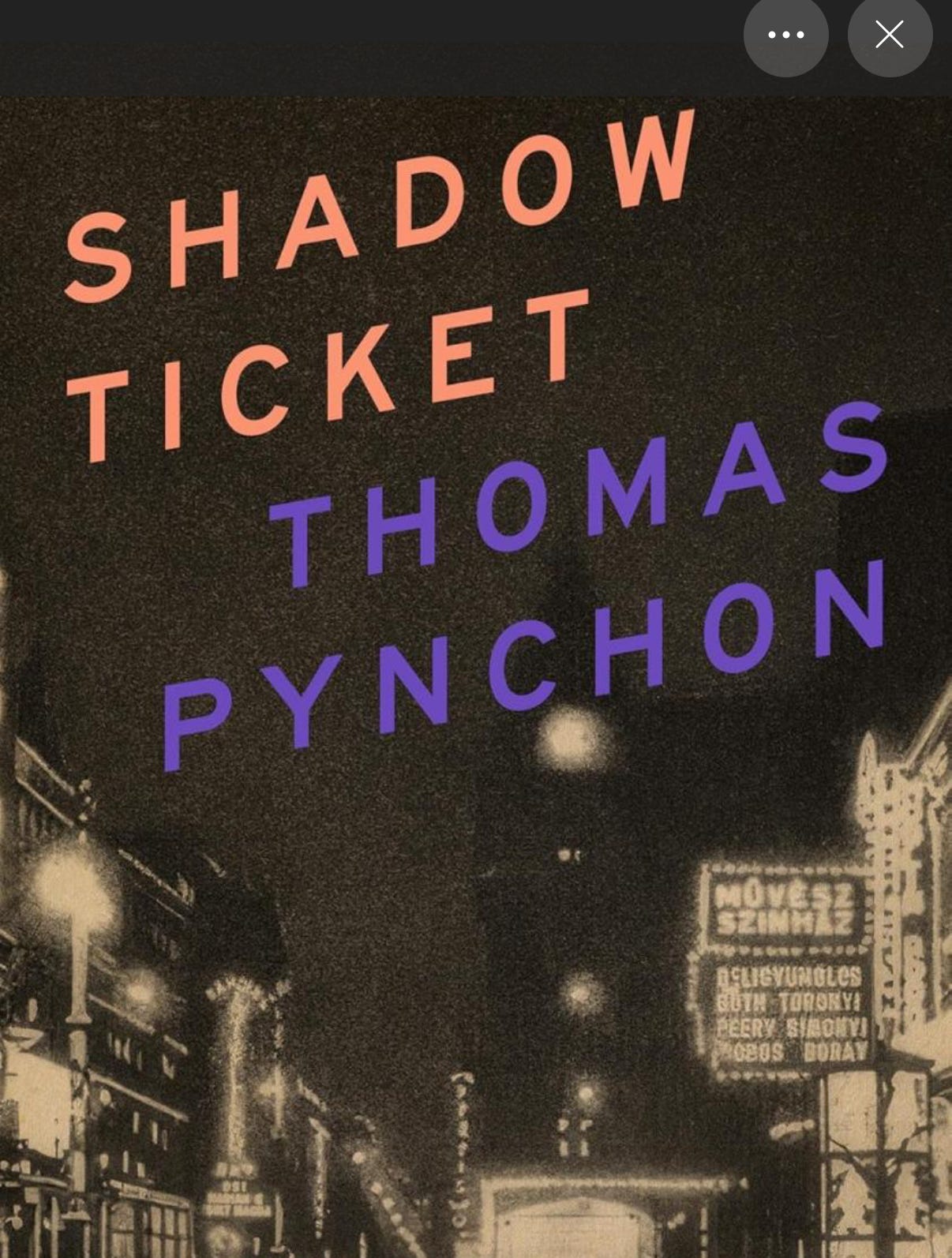
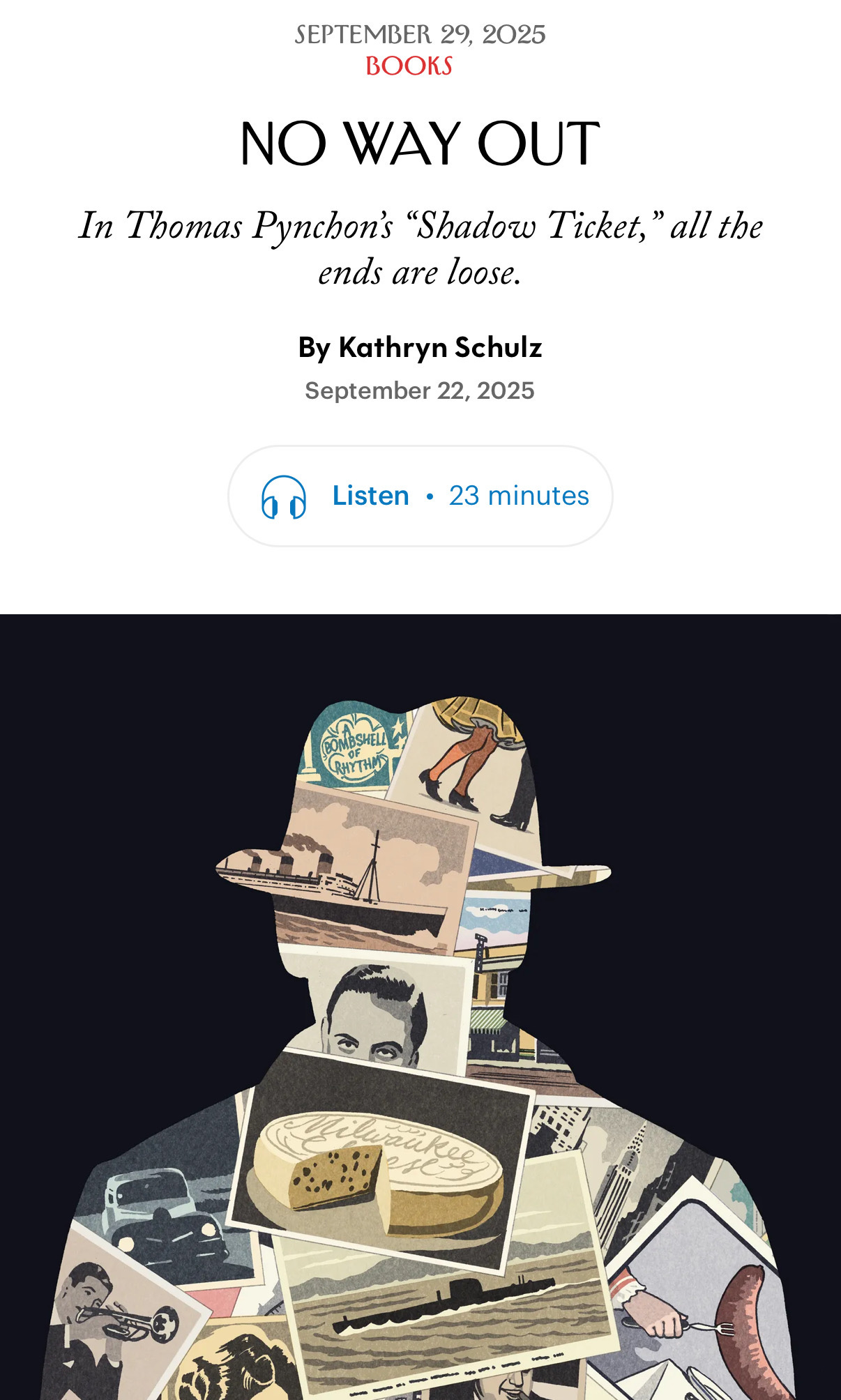
I'm not writing a review of the book here. But it tells a story of Hicks McTaggert, a former union-busting tough who shifted to the private investigation business. It is the early 1930s in Milwaukee, shortly before the repeal of Prohibition and concurrent with the rise to power of Adolf Hitler. Hicks is tasked with tracking down the heiress of the cheese empire run by Bruno Airmont, "the Al Capone of Cheese". She absconded with a Jewish swing clarinetist, Hop Wingdale, leaving behind a fiance ... and her money and reputation. Hicks knows her because, a brilliant hoofer in his spare time, they danced together before Hicks found himself rescuing her from pursuers, leaving her at an Indian reservation along Lake Michigan. Though Hicks doesn't want this work, a conspiracy that seems to extend from his employer to the British intelligence agency puts him aboard an ocean liner headed to Central Europe so he can chase the heiress and, ultimately, Bruno himself. (For the record: the mob really was engaged in manipulating the cheese market in the 1930s!)
Hijinx ensue, certainly. A WW1 Uboat previously seen under the ice of Lake Michigan is on hand. Motorcycle gangs and Nazis mix. The systems of corporate power that will undergird the next war are gathering - a story that is told in Gravity's Rainbow, more or less.
And other connections to previous Pynchon novels appear. Hicks and his kinda apprentice, one Floyd Francis "Skeet" Wheeler, are both in touch with a PI named Lew Basnight, out of Chicago and Against The Day. And Skeet? We'll we learn in the book's coda that he is off for California, the very place where a man named Zoyd Wheeler will eventually be crashing through a plate glass window in the opening chapter of Vineland.
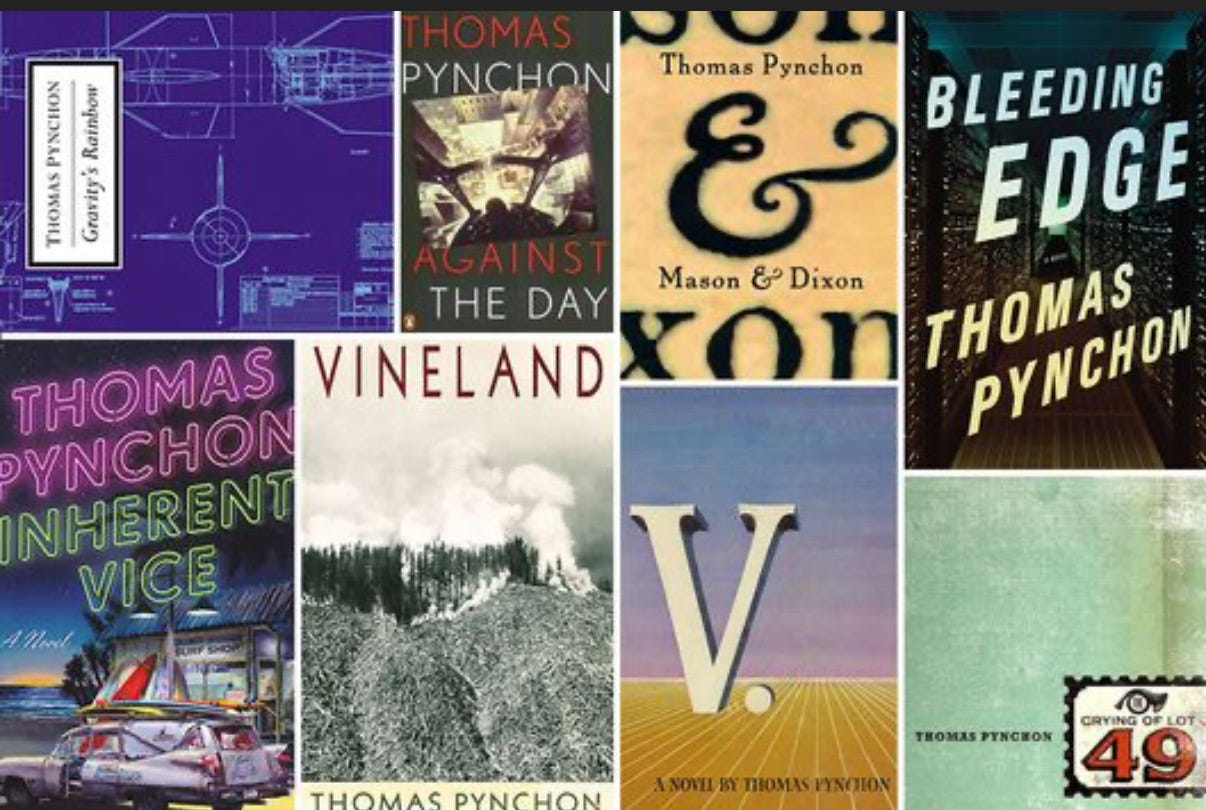
The Pynchon novels turn out to be a gargantuan interconnected story that covers just about the entire history of the 20th century, starting with ATD's invocation of the 1893 World's Fair and ending with Bleeding Edge's slant depiction of the 9/11 destruction of New York's World Trade Center towers. (Only Mason & Dixon sits outside this timeline.) This huge work of art is not a realistic portrait of one person or family but an Off-Broadway, amusical, a cartoon, a pulp detective movie, a 20th century creation that wants to explain something to us about that "American Century." It is a symbolic work - a piece of art that is using its form, its literary voice, and its comic but dead serious angle on the world to tell us why we ought to be scared and to provide a strategy or two that might offer hope.
Shadow Ticket does its work while winking, dancing, and swinging like mad. It's fun and, unlike many of his books, it isn't particularly hard to follow. It simply plunges our "detective" into a mysterious landscape where we become the detective - we see how individual lives get sucked into the dynamics of a world slipping toward fascism and corporate greed. Some people will resist the darkness and most, understandably, will fail. There are forces unseen but often felt.
Now that I have read all of these books, I don't pretend to have it all figured out, and I'm okay if the author himself doesn't either. I would, frankly, prefer it if he wasn't another master of control - the kind of character who is a typical "heavy" in his own books. And see these books less as the equivalent or peer of Ulysses or Moby Dick and more like a fantastical serial - maybe the Superman comics had they been written by Jack Kerouac? Maybe Faulkner if he had developed a taste for hallucinagens? Maybe Eric Dolphy, the alto saxophonist, if he had chosen to be a novelist with Raymond Chandler as his role model.
However you see this work, it's true that Pynchon's oeuvre isn't a that of the traditional novel. He uses the form with an avant garde plasticity, a love of genre fiction, film culture, and verbal daring. The fantastical and farcical are there to serve some dead serious ends. Is our world in a death spiral or is mankind capable of surprising, against-the-odds hope?
Critics are, of course, allowed to like or dislike novels (or paintings or music or ...) in any style, and no reflection like this one is going change whether Shadow Ticket or any other tale connects with a critical reader.
But there ought to be a hundred ways to write a great novel - not just the "emotionally and literally realistic" way. Works that use humor or symbolism, farce or parody, cartoon-like exaggeration or dense explanation of historical events and trends and patterns - are be telling fresh stories with daring and creativity.
I know the low-hanging critical fruit that post-modernism presents: all those guys, walking around Brooklyn with Infinite Jest jutting brazenly out of their Chrome messenger bags, eager to talk to anyone about the new Paul Thomas Anderson movie over a double IPA. (On the other hand: do men even read books anymore? Has this particular cliche actually become moot?)
A critic's reaction that any writer isn't using the most conventional tools currently in style is lazy and narrow.
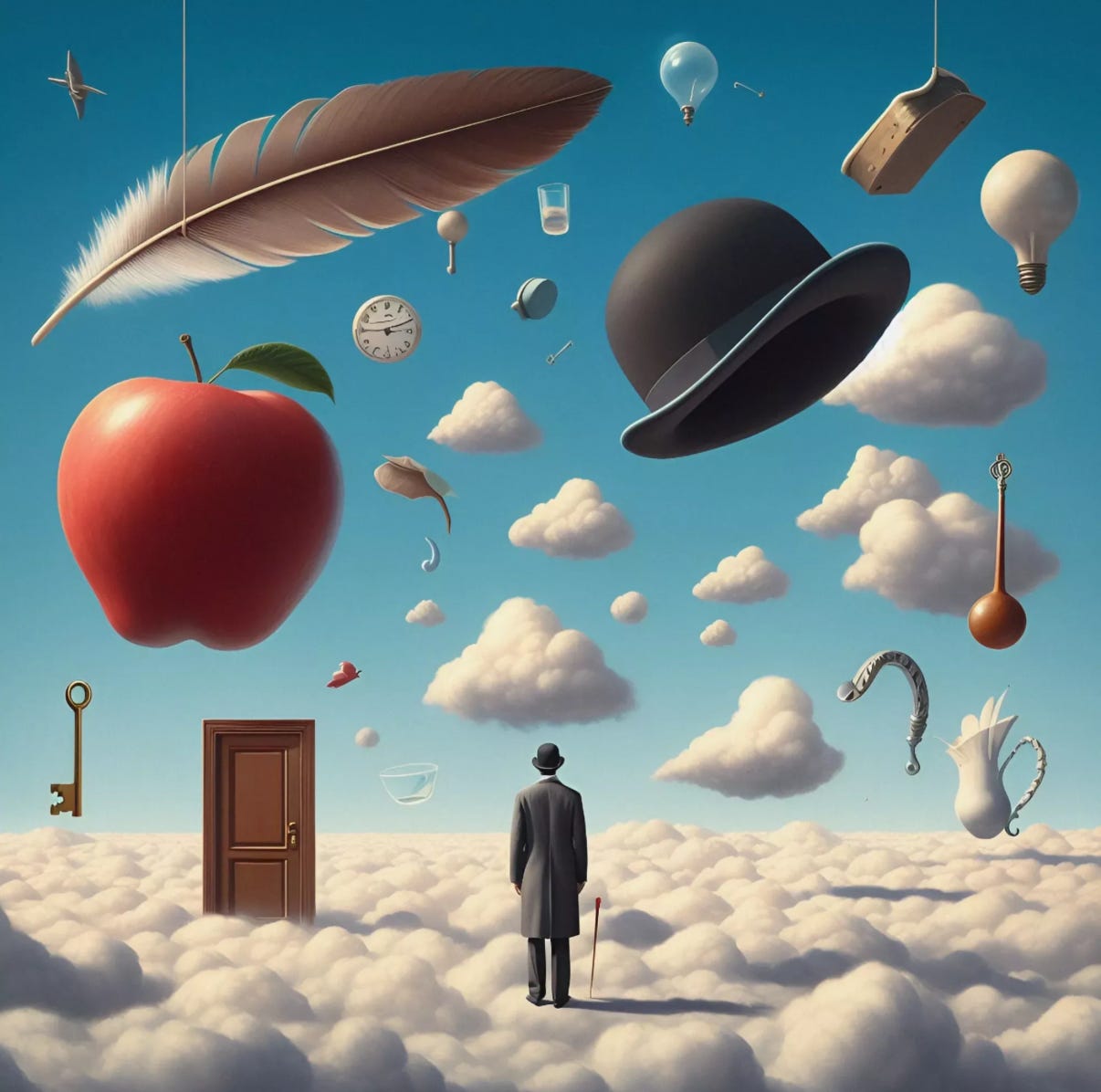
Rene Magritte’s most famous paintings often had titles that defied the images themselves or posed question through absurd juxtapositions. "Attempting the Impossible" - exactly. A WW1 German Uboat surely never could have transported a Chicago mob figure from Milwaukee to Budapest (Shadow Ticket) and there is no evidence I'm aware of that a civization lives inside the crust of the Earth (Against The Day). If his work is "literature" rather than sci-fi or fantasy, then critics seem driven to ask for more realistic portraits and fewer plot-convenient coincidences. But Thomas Pynchon's books are hunting different prey - a tracing of the shape of modern life using crayons as well as pen, animation as well as oil paint.
If writing with this kind of vigor and neon zing of has been out of vogue for 35 years, then I think we are living on scraps and gruel.
A respectable man in a bowler hat can have an apple for a face. In fact, maybe he does.